

FAQ: Contract Enforcement & Remedies in Contract Law
When a contract is breached or disputed, the law provides several remedies designed to either enforce the agreement or compensate the harmed party. These remedies exist to restore fairness, protect expectations, and prevent unjust outcomes.
Some remedies focus on forcing performance, while others aim to financially compensate or undo unfair reliance. Below are four important doctrines used in contract enforcement: specific performance, consequential damages, restitution, and promissory estoppel.
What Is Specific Performance in Contract Law?
Specific performance is a legal remedy where a court orders a party to carry out their contractual promise instead of simply paying money for breaching the agreement.
In most contract disputes, the injured party receives financial damages. However, in certain situations, money alone cannot fix the problem. When that happens, a court may require the breaching party to perform exactly what they agreed to do.
This remedy is not automatic. Courts use it carefully and only in limited circumstances.
Purpose of Specific Performance
The purpose of specific performance is to enforce the original agreement when monetary damages would be inadequate.
The law recognizes that some things are too unique or valuable to be replaced with money. If the injured party cannot reasonably obtain a substitute, the court may step in and require the contract to be fulfilled as promised.
The goal is to place the injured party in the position they would have been in if the contract had been performed.
Unique Subject Matter
Specific performance is most commonly granted when the contract involves something unique.


Examples include:
- Real estate
- Rare goods
- Specialized commercial equipment
- Unique business assets
Requirements for Specific Performance
To obtain specific performance, the requesting party generally must prove:
- A valid and enforceable contract exists.
- The contract terms are clear and definite.
- Monetary damages would not adequately compensate the loss.
- The requesting party has fulfilled (or is ready to fulfill) their own obligations.
Courts will carefully examine the fairness of the agreement and whether enforcing it would be practical.
Limitations of Specific Performance
Specific performance is an equitable remedy, which means judges have discretion in deciding whether to grant it.
Courts usually will not order specific performance in cases involving:
- Personal service contracts (a court cannot force someone to work)
- Agreements requiring ongoing supervision
- Situations where performance is impossible
- Contracts that would cause undue hardship
Because it is discretionary, even a technically valid request may be denied if enforcement would be unfair.
Common Applications
Specific performance most often appears in:
- Real estate disputes
- Commercial property transactions
- Contracts involving rare or unique assets
- High-value business sales
It is far less common in routine sales of goods or service agreements.
How It Differs From Monetary Damages
Monetary damages compensate a party for the financial loss caused by a breach. Specific performance, on the other hand, compels the breaching party to complete the transaction.
For example:
If a supplier fails to deliver standard inventory items, damages would likely be sufficient.
If a seller refuses to transfer a one-of-a-kind property, specific performance may be appropriate.
Bringing It Together
Specific performance exists to protect the integrity of agreements involving unique or irreplaceable subject matter.
It reinforces the principle that some promises carry value beyond dollars and cents. However, because it is a powerful remedy, courts apply it cautiously and only when financial compensation would not truly resolve the harm.
What Are Consequential Damages in Contract Law?
Consequential damages are compensation for losses that occur as a result of a contract breach—but not from the breach itself.
Instead of covering only the immediate failure to perform, consequential damages address the ripple effects that follow. These damages recognize that broken contracts often create broader financial harm beyond the original agreement.
For example, if a supplier fails to deliver critical equipment on time, the buyer may not only lose the equipment—they may also lose customers, miss deadlines, or suffer business interruptions. Those secondary losses are what consequential damages are designed to address.
Purpose of Consequential Damages
The purpose of consequential damages is to compensate a party for foreseeable losses caused by a breach of contract.
They exist to place the injured party in the position they would have been in had the contract been performed properly, including losses that extend beyond the direct value of the agreement.
Key Requirements for Consequential Damages
Courts generally require several elements before awarding consequential damages.
Foreseeability
The losses must have been reasonably foreseeable when the contract was formed.
This means the breaching party either knew—or should have known—that their failure would likely cause certain types of harm.
For example, if a vendor knows their product is required for a business launch, lost profits from a delayed opening may be considered foreseeable.
There must be a clear connection between the breach and the claimed damages.
If losses are too remote or unrelated, courts will not award compensation.
Reasonable Certainty
The injured party must prove damages with reasonable accuracy. Courts will not award speculative or hypothetical losses.
Business records, invoices, and financial statements are often used to establish this.
Duty to Mitigate
The injured party must take reasonable steps to reduce their losses.
For example, if alternative suppliers are available, a business cannot simply wait and allow damages to grow unnecessarily.
Common Examples of Consequential Damages
Consequential damages may include:
- Lost profits
- Business interruption losses
- Lost customers
- Increased operating costs
- Missed business opportunities
These damages go beyond the price of the contract itself.
How Consequential Damages Differ From Direct Damages
Understanding this distinction is important.
Direct damages compensate for the immediate breach.
Example: A supplier fails to deliver $10,000 worth of materials.
Consequential damages compensate for secondary losses.
Example: Because the materials never arrived, the buyer lost a $50,000 client contract.
Direct damages address the broken promise. Consequential damages address the business fallout.
Contract Limitations and Waivers
Many contracts include clauses that limit or exclude consequential damages.
Courts often enforce these provisions unless they are unconscionable or violate public policy. This is why carefully reviewing contract terms is critical before signing.
Bringing It Together
Consequential damages recognize that contract breaches often affect entire business operations, not just individual transactions.
However, courts apply strict standards. Losses must be foreseeable, provable, and directly linked to the breach. Businesses should understand both their potential exposure and their rights when drafting agreements.
What Is Restitution in Contract Law?
Restitution is a legal remedy designed to prevent one party from unfairly benefiting at another’s expense.

Rather than enforcing a contract or awarding expectation damages, restitution focuses on restoring what was unjustly gained.
In simple terms, restitution requires a party to give back benefits they should not have received.
Purpose of Restitution
The purpose of restitution is fairness.
It ensures that someone who received value—such as money, labor, or materials—cannot keep it when doing so would be unjust.
Restitution applies even when no enforceable contract exists.
When Restitution Is Commonly Used
Restitution often arises when:
- A contract is invalid or unenforceable
- An agreement is canceled or rescinded
- Services were performed without proper compensation
- A party obtained benefits through mistake, misrepresentation, or unfair conduct
It fills gaps where traditional contract remedies may not apply.
How Restitution Is Measured
Courts calculate restitution based on the reasonable value of benefits provided.
This may include:
- Labor performed
- Materials supplied
- Payments made
- Property transferred
The focus is not on what was promised—but on what was received.
Example of Restitution
Imagine a contractor begins work under an agreement later found invalid. Even though the contract cannot be enforced, the contractor may still recover payment for the value of services provided.
Without restitution, the property owner would unfairly benefit from free labor.
Restitution vs. Other Contract Remedies
This is where many people get confused.
Let’s compare:
Contract Damages
These enforce expectations.
Example: You recover profits you expected from the deal.
Reliance Damages
These reimburse expenses incurred.
Example: You recover money spent preparing for the contract.
Restitution
This removes unjust benefit.
Example: The other party must return money or value they received.
Each remedy serves a different purpose.
Additional Situations Where Restitution Applies
Restitution may also be available in cases involving:
- Fraud or misrepresentation
- Failed agreements
- Partial performance
- Mistaken payments
It is rooted in equity rather than contract enforcement.
Bringing It Together
Restitution exists to prevent unfair enrichment.
When one party receives benefits without a valid legal basis, restitution allows courts to restore balance by requiring repayment or compensation. It ensures fairness even when formal contracts fail.
What Is Promissory Estoppel in Contract Law?
Promissory estoppel is a legal principle that allows a court to enforce a promise even when no formal contract exists.
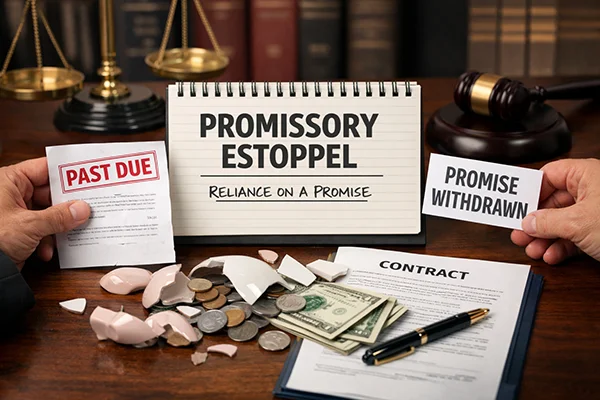
Normally, contracts require offer, acceptance, and consideration. Promissory estoppel applies when one party makes a promise, another party reasonably relies on that promise, and harm results. In these situations, courts may step in to prevent unfair outcomes—even though traditional contract requirements were never fully met.
In simple terms, promissory estoppel exists to stop people from backing out of serious promises when others have relied on them.
Purpose of Promissory Estoppel
The purpose of promissory estoppel is to prevent injustice.
It protects people who take action based on a promise that later gets withdrawn. Without this doctrine, someone could make assurances, watch another party incur expenses or change their position, then walk away without consequences.
Promissory estoppel fills that gap by holding promise-makers accountable when fairness demands it.
Key Elements of Promissory Estoppel
Courts generally require four elements.
Clear and Definite Promise
There must be a specific promise—not vague statements or casual remarks.
For example, saying “I might hire you someday” is not enough. But promising “You have the job starting next month” may qualify.
The promise must be clear enough that a reasonable person would treat it seriously.
Reasonable Reliance
The person receiving the promise must reasonably rely on it.
This means they took action—or refrained from taking action—because they believed the promise would be honored.
Examples include:
- Quitting a job based on a new employment promise
- Purchasing materials based on assurances of payment
- Turning down other opportunities after being promised a deal
The reliance must be reasonable under the circumstances.
Detriment Suffered
The relying party must experience actual harm.
This could involve financial loss, lost opportunities, or other measurable setbacks. Courts do not apply promissory estoppel unless real damage occurred.
Avoiding Injustice
Finally, courts must determine that enforcing the promise is necessary to prevent unfairness.
If backing out of the promise would leave the injured party worse off—and the promisor knew reliance was likely—courts may intervene.
How Promissory Estoppel Works in Real Life
Here’s a simple example:
A business owner promises a contractor steady work for six months. Based on that promise, the contractor turns down other projects and hires additional staff. Two weeks later, the business cancels without warning.
Even if no formal contract exists, the contractor may seek relief under promissory estoppel because:
Allowing the business to walk away would be unfair
- A clear promise was made
- The contractor reasonably relied on it
- Financial harm resulted
- Allowing the business to walk away would be unfair
Promissory Estoppel as an Alternative to a Contract
Promissory estoppel does not replace contracts.
Instead, it applies when a contract fails or never existed, but fairness still requires protection.
It is often used when:
- Negotiations break down after promises were made
- Agreements were informal
- Technical contract elements are missing
- Written contracts were never finalized
Remedies Available Under Promissory Estoppel
Courts typically award damages designed to compensate reliance—not expected profits.
This may include:
- Out-of-pocket expenses
- Lost opportunities
- Costs incurred based on the promise
Unlike traditional contracts, courts usually do not award full benefit-of-the-bargain damages.
Where Promissory Estoppel Comes From
Promissory estoppel originated in equity courts, which focus on fairness rather than rigid legal rules.
It developed as a way to protect people from harmful reliance when formal contracts could not.
Important Limitations
Promissory estoppel is applied narrowly.
Courts will not enforce casual statements, vague promises, or situations where reliance was unreasonable. It is reserved for clear cases of injustice.
Bringing It All Together
Promissory estoppel exists to protect trust in serious promises.
When someone makes a commitment knowing another person will rely on it, the law may step in to prevent unfair harm—even without a traditional contract.
For businesses and individuals alike, it serves as a reminder that promises can carry legal consequences, especially when others take action based on them.
Understanding Contract Enforcement & Remedies
Contract law does not just define how agreements are formed—it also provides tools for resolving disputes when things go wrong. Whether the issue involves forcing performance through specific performance, recovering indirect losses through consequential damages, restoring fairness through restitution, or protecting reliance through promissory estoppel, each remedy serves a different purpose.
The key takeaway is that not every breach is handled the same way. The appropriate remedy depends on the nature of the agreement, the harm suffered, and what outcome will most fairly address the situation. Understanding these concepts helps business owners and individuals evaluate risk, draft stronger agreements, and respond more effectively when disputes arise.
If you are facing a contract dispute or have questions about enforcing—or defending against—contract claims, speaking with an experienced business attorney can help you assess your options and determine the most practical path forward.