

FAQ: Improper Pressure & Unfair Influence in Contract Law
Contracts are meant to reflect voluntary, informed agreements between parties. But sometimes, one side applies improper pressure or takes advantage of another person’s vulnerability. When that happens, the law may step in.
Two common doctrines address these situations: undue influence and duress. While they are related, they apply in different circumstances and rely on different legal standards.
Below is a breakdown of how each works, how courts evaluate these claims, and what happens when improper pressure affects a contract.
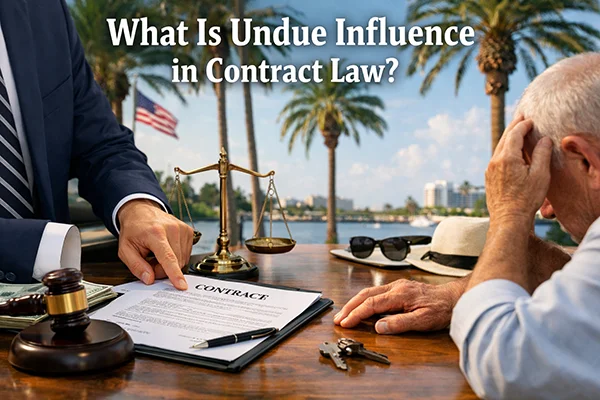
What Is Undue Influence in Contract Law?
Undue influence occurs when one party uses their position of power, trust, or authority to override another person’s free will during contract formation. Instead of making an independent decision, the influenced party is persuaded in a way that feels coercive—even if no direct threats are made.
At its core, undue influence focuses on unfair persuasion, not force.
Key Aspects of Undue Influence
Definition
Undue influence arises when a dominant party improperly persuades a vulnerable party to agree to terms they otherwise would not accept.
Vulnerability
Courts often look at whether one party was especially susceptible due to:
- Age
- Illness or disability
- Emotional distress
- Financial hardship
- Lack of business experience
Being vulnerable does not automatically prove undue influence—but it raises red flags.

Relationship Between the Parties
Undue influence frequently appears in relationships involving trust or dependency, such as:
- Business partners
- Family members
- Caregivers
- Advisors or fiduciaries
When one party relies heavily on the other, courts may scrutinize the transaction more closely.
Voidable Contracts
If undue influence is proven, the contract is usually voidable, meaning the affected party can choose to cancel it.
Types of Undue Influence
Actual Undue Influence
This involves direct evidence of improper persuasion, such as:
- Persistent pressure
- Manipulation
Isolation from outside advice - Emotional leverage
Here, the burden is on the influenced party to show that unfair tactics were used.
Presumed Undue Influence
In certain relationships (like fiduciary or confidential relationships), courts may presume undue influence once:
- A relationship of trust is established, and
- The transaction appears one-sided or unusual
The burden then shifts to the dominant party to prove the agreement was fair and voluntary.
Common Factors and Evidence
Courts often consider:
- Whether independent legal advice was available
- Sudden changes to long-standing agreements
- Unusual benefits to one party
- Timing (such as signing during illness or crisis)
- Lack of transparency
No single factor is decisive—judges look at the full context.
Difference Between Undue Influence and Duress
Although both involve pressure, they are legally distinct:
- Undue influence centers on manipulation and imbalance of power.
- Duress involves threats or coercion.
Undue influence is subtle. Duress is more direct.
What Is Duress in Contract Law?
Duress occurs when one party forces another to enter a contract through threats or wrongful pressure. Unlike undue influence, duress typically involves explicit coercion.
A contract signed under duress is not considered voluntary.
Key Aspects of Duress in Contract Law

Definition
Duress exists when a person agrees to a contract because of improper threats that leave them with no reasonable alternative.
Voidable Contracts
Like undue influence, contracts formed under duress are generally voidable at the option of the coerced party.
Types of Duress
Physical Duress
This involves threats of bodily harm or actual violence. Contracts signed under physical threat are almost always invalid.
Economic Duress
This occurs when one party uses financial pressure improperly, such as:
- Threatening to breach a contract unless new terms are accepted
- Withholding payment to force concessions
- Exploiting urgent financial need
Economic pressure alone is not enough—it must be wrongful and leave no reasonable choice.
Goods or Property Duress
This involves threats to withhold or damage property unless demands are met.
Elements Required to Prove Duress
To succeed on a duress claim, courts typically look for:
Improper or Illegitimate Threat
The pressure must go beyond hard bargaining and enter wrongful territory.
No Reasonable Alternative
The victim must show they had no practical option except to agree.
Subjective Coercion
The threat must actually have caused the party to consent.
Differences From Other Contract Doctrines
Duress differs from related concepts like:
- Fraud (misrepresentation of facts)
- Mistake (shared misunderstanding)
- Undue influence (exploitation of trust rather than threats)
Each doctrine has its own legal requirements.
Legal Consequences of Improper Pressure
When undue influence or duress is proven, courts may:
- Rescind the contract
- Restore parties to their prior positions
- Award damages in certain cases
Timing matters. A party seeking relief should act promptly once the pressure ends.
Final Thoughts
Both undue influence and duress exist to protect fairness in contract law. Whether the pressure comes through manipulation or direct threats, agreements must be made freely to be enforceable.
In Florida, these doctrines frequently arise in business disputes, partnership disagreements, and contract renegotiations—especially when one party holds significantly more leverage than the other.
If you believe improper pressure played a role in a contract affecting your business, speaking with a qualified business attorney near Clearwater can help clarify your options and protect your interests before issues escalate.